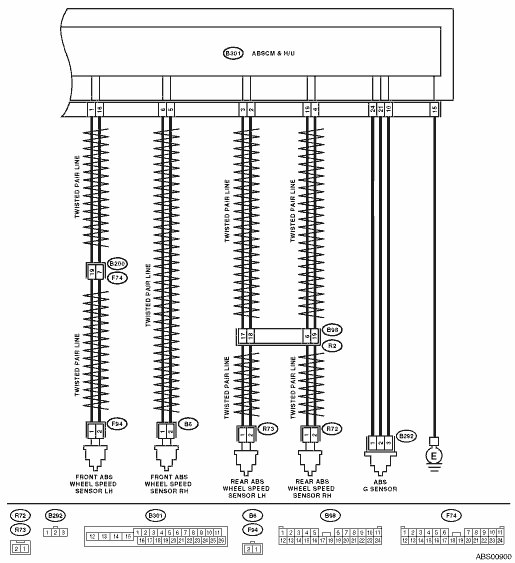
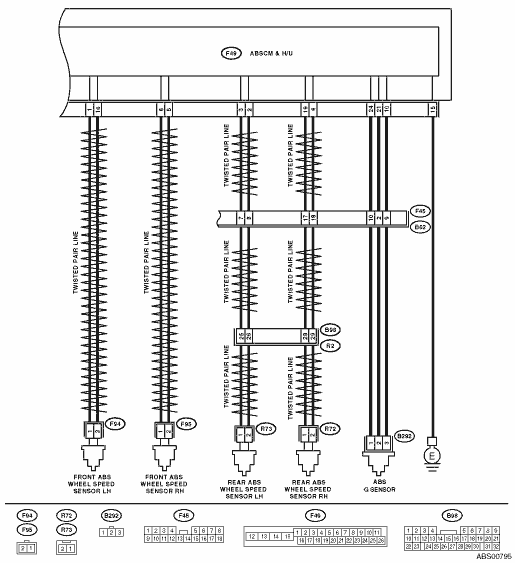
1.CHECK OUTPUT OF ABS WHEEL SPEED SENSOR USING SUBARU SELECT MONITOR.
1) Select {Current Data Display & Save} in Subaru Select Monitor.
2) Read the ABS wheel speed sensor output corresponding to the faulty system in Subaru Select Monitor display mode.
|
Does the speed indicated on the display change in response to the speedometer reading during acceleration or deceleration when the steering wheel is in the straight-ahead position?
|
|
|
2.CHECK POOR CONTACT IN CONNECTOR.
Turn the ignition switch to OFF.
|
Is there poor contact in connectors between ABSCM&H/U and ABS wheel speed sensor?
|
|
|
3.CHECK CAUSE OF SIGNAL NOISE.
|
Is the car telephone or the radio properly installed?
|
|
Install the car phone or radio properly.
|
4.CHECK CAUSE OF SIGNAL NOISE.
|
Is there a noise source (such as an antenna) installed near the sensor harness?
|
Install the noise source apart from the sensor harness.
|
|
5.CHECK ABSCM&H/U.
1) Connect all connectors.
3) Perform the Inspection Mode.
|
Is the same DTC still output?
|
Replace the ABSCM only. 
|
|
6.CHECK OTHER DTC DETECTION.
|
Is there any other DTC detected?
|
Perform the diagnosis according to DTC.
|
It results from a temporary noise interference.
|
7.CHECK INSTALLATION OF ABS WHEEL SPEED SENSOR.
|
Is the ABS wheel speed sensor installation bolt tightened to 33 N·m (3.4 kgf-m, 25 ft-lb)?
|
|
Tighten the ABS wheel speed sensor installation bolts.
|
8.CHECK ABS WHEEL SPEED SENSOR GAP.
Measure the gap between the ABS wheel speed sensor protrusion and tone wheel.
|
Is the gap within the following? Front wheel: 0.3 — 0.8 mm (0.012 — 0.031 in); Rear wheel: 0.7 — 1.2 mm (0.028 — 0.047 in)
|
|
Adjust the gap.
NOTE:
Adjust the gap using spacers (Part No. 26755AA000). If spacers cannot correct the gap, replace the worn sensor or worn tone wheel.
|
|
|
Is an oscilloscope available?
|
|
|
10.CHECK ABS WHEEL SPEED SENSOR SIGNAL.
2) Turn the ignition switch to OFF.
3) Connect the oscilloscope to the connector.
4) Turn the ignition switch to ON.
5) Start the wheel, and measure the voltage at the specified frequency.
NOTE:
When this inspection is completed, ABSCM&H/U may record DTC 29 or DTC 56.
Connector & terminal
DTC 22
LHD model
(B6) No. 1 (+) — No. 2 (−):
RHD model
(F95) No. 1 (+) — No. 2 (−):
DTC 24
(F94) No. 1 (+) — No. 2 (−):
DTC 26
LHD model
(B98) No. 6 (+) — No. 19 (−):
RHD model
(B98) No. 28 (+) — No. 29 (−):
DTC 28
LHD model
(B98) No. 18 (+) — No. 17 (−):
RHD model
(B98) No. 26 (+) — No. 25 (−):
|
Is the oscilloscope pattern the same voltage as shown in the table?
|
|
|
11.CHECK CONTAMINATION OF ABS WHEEL SPEED SENSOR OR TONE WHEEL.
Remove the disc rotor or drum from the hub according to the DTC.
|
Is the ABS wheel speed sensor piece or the tone wheel contaminated by dirt or other foreign matter?
|
Thoroughly remove dirt or other foreign matter.
|
|
12.CHECK DAMAGE OF ABS WHEEL SPEED SENSOR OR TONE WHEEL.
|
Is there damage in the protrusion of the ABS wheel speed sensor or the tone wheel?
|
|
|
13.CHECK TONE WHEEL RUNOUT.
Measure the tone wheel runout.
|
Is the runout less than 0.05 mm (0.0020 in)?
|
|
Replace the tone wheel. Front: Rear:
|
14.CHECK RESISTANCE OF THE ABS WHEEL SPEED SENSOR.
1) Turn the ignition switch to OFF.
2) Disconnect the connector from the ABS wheel speed sensor.
3) Measure the resistance of the ABS wheel speed sensor connector terminals by shaking the harness lightly.
|
Is the resistance within the following? Front: 1 — 1.5 kΩ Rear: 1.025 — 1.265 kΩ
|
|
Replace the ABS wheel speed sensor. Front: Rear:
|
15.CHECK GROUND SHORT OF ABS WHEEL SPEED SENSOR.
Measure the resistance between ABS wheel speed sensor and chassis ground.
Connector & terminal
Front RH
No. 1 — Chassis ground:
Front LH
No. 1 — Chassis ground:
Rear RH
No. 1 — Chassis ground:
Rear LH
No. 1 — Chassis ground:
|
Is the resistance more than 1 MΩ?
|
|
Replace the ABS wheel speed sensor. Front: Rear:
|
16.CHECK HARNESS CONNECTOR BETWEEN ABSCM&H/U AND ABS WHEEL SPEED SENSOR.
1) Connect the connector to the ABS wheel speed sensor.
2) Disconnect the ABSCM&H/U connectors.
3) Measure the resistance between ABSCM&H/U connector terminals.
Connector & terminal
DTC 22
LHD model
(B301) No. 6 — No. 5:
RHD model
(F49) No. 6 — No. 5:
DTC 24
LHD model
(B301) No. 1 — No. 16:
RHD model
(F49) No. 1 — No. 16:
DTC 26
LHD model
(B301) No. 19 — No. 4:
RHD model
(F49) No. 19 — No. 4:
DTC 28
LHD model
(B301) No. 3 — No. 2:
RHD model
(F49) No. 3 — No. 2:
|
Is the resistance within the following? Front: 1 — 1.5 kΩ Rear: 1.025 — 1.265 kΩ
|
|
Repair the harness connector between ABSCM&H/U and ABS wheel speed sensor.
|
17.CHECK GROUND SHORT OF HARNESS.
Measure the resistance between the ABSCM&H/U connector and chassis ground.
Connector & terminal
DTC 22
LHD model
(B301) No. 6 — Chassis ground:
RHD model
(F49) No. 6 — Chassis ground:
DTC 24
LHD model
(B301) No. 1 — Chassis ground:
RHD model
(F49) No. 1 — Chassis ground:
DTC 26
LHD model
(B301) No. 19 — Chassis ground:
RHD model
(F49) No. 19 — Chassis ground:
DTC 28
LHD model
(B301) No. 3 — Chassis ground:
RHD model
(F49) No. 3 — Chassis ground:
|
Is the resistance more than 1 MΩ?
|
|
Repair the harness connector between ABSCM&H/U and ABS wheel speed sensor.
|
18.CHECK THE ABSCM&H/U GROUND CIRCUIT.
Measure the resistance between the ABSCM&H/U and chassis ground.
Connector & terminal
LHD model
(B301) No. 15 — Chassis ground:
RHD model
(F49) No. 15 — Chassis ground:
|
Is the resistance less than 0.5 Ω?
|
|
Repair the ABSCM&H/U ground harness.
|
19.CHECK POOR CONTACT IN CONNECTOR.
|
Is there poor contact in connectors between ABSCM&H/U and ABS wheel speed sensor?
|
|
|
20.CHECK CAUSE OF SIGNAL NOISE.
|
Is the car telephone or the radio properly installed?
|
|
Install the car phone or radio properly.
|
21.CHECK CAUSE OF SIGNAL NOISE.
|
Is there a noise source (such as an antenna) installed near the sensor harness?
|
Install the noise source apart from the sensor harness.
|
|
22.CHECK ABSCM&H/U.
1) Connect all connectors.
3) Perform the Inspection Mode.
|
Is the same DTC still output?
|
Replace the ABSCM only.
|
|
23.CHECK OTHER DTC DETECTION.
|
Is there any other DTC detected?
|
Perform the diagnosis according to DTC.
|
It results from a temporary noise interference.
NOTE:
Though the ABS warning light remains on at this time, this is normal. Drive the vehicle at more than 12 km/h (7.46 MPH) in order to turn ABS warning light off. Be sure to drive the vehicle and check that the warning light goes off.
|