1. HOW TO USE GENERAL SCAN TOOL
1. Prepare a scan tool (general scan tool) required by SAE J1978.
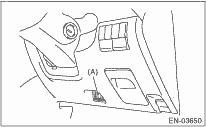
2. Connect the general scan tool to data link connector located in the lower portion of the instrument panel (on the driver’s side).
|
(A) |
Data link connector |
3. Using the general scan tool, call up DTC and freeze frame data.
General scan tool functions consist of:
(1) MODE $01: Current powertrain diagnostic data
(2) MODE $02: Powertrain freeze frame data
(3) MODE $03: Emission-related powertrain DTC
(4) MODE $04: Clear/Reset emission-related diagnostic information
Read out the data according to repair procedures. (For detailed operation procedure, refer to the general scan tool instruction manual.)
NOTE:
For details concerning DTC, refer to “List of Diagnostic Trouble Code (DTC)”. 
2. MODE $01 (CURRENT POWERTRAIN DIAGNOSTIC DATA)
Refer to data denoting the current operating condition of analog input/output, digital input/output or the powertrain system.
A list of the support data and PID (Parameter Identification) codes are shown in the following table.
|
PID |
Data |
Unit of measure |
|
01 |
Number of emission-related powertrain DTC and malfunction indicator light status |
ON/OFF |
|
03 |
Fuel system control status |
— |
|
04 |
Calculated engine load value |
% |
|
05 |
Engine coolant temperature |
°C |
|
06 |
Short term fuel trim |
% |
|
07 |
Long term fuel trim |
% |
|
0B |
Intake manifold absolute pressure |
kPa |
|
0C |
Engine speed |
rpm |
|
0D |
Vehicle speed |
km/h |
|
0E |
Ignition timing advance |
° |
|
$1F |
Elapsed time after engine start |
sec |
|
10 |
Air flow rate of manifold absolute pressure sensor |
g/sec |
|
11 |
Throttle valve opening angle |
% |
|
13 |
Check whether oxygen sensor is installed. |
— |
|
14 |
Oxygen sensor output voltage and short term fuel trim — bank 1 associated with oxygen sensor |
V and % |
|
15 |
Oxygen sensor output voltage and short term fuel trim — bank 2 associated with oxygen sensor |
V and % |
|
1C |
On-board diagnostic system |
— |
|
$24 |
A/F sensor (λ and voltage) (Bank 1) |
— and V |
|
$2C |
Target EGR |
% |
|
$2D |
EGR deviation |
% |
|
$2E |
Evaporative purge |
% |
|
$2F |
Fuel Level |
% |
|
$30 |
Warm-up frequency after DTC clear |
— |
|
$31 |
Driving distance after DTC clear |
km |
|
$33 |
Atmosphere pressure |
mmHg |
|
$34 |
A/F sensor (λ and current) (Bank 1) |
— and mA |
|
$41 |
Diagnosis monitoring per driving cycle |
— |
|
$42 |
ECM power supply voltage |
V |
|
$43 |
Absolute load |
% |
|
$44 |
A/F target lambda |
— |
|
$45 |
Relative throttle opening angle |
% |
|
$46 |
Ambient temperature |
°C |
|
$47 |
Absolute throttle opening angle 2 |
% |
|
$49 |
Absolute accelerator opening angle 1 |
% |
|
$4A |
Absolute accelerator opening angle 2 |
% |
|
$4C |
Target throttle opening angle |
% |
|
$4D |
Engine operating time during MIL illumination |
min |
|
$4E |
Elapsed time after DTC clear |
min |
|
$51 |
Fuel used |
— |
|
$5A |
Relative throttle opening angle |
% |
NOTE:
Refer to general scan tool manufacturer’s instruction manual to access current powertrain diagnostic data (MODE $01).
3. MODE $02 (POWERTRAIN FREEZE FRAME DATA)
Refer to data denoting the operating condition when trouble is detected by on-board diagnosis system.
A list of the support data and PID (Parameter Identification) codes are shown in the following table.
|
PID |
Data |
Unit of measure |
|
$02 |
DTC that caused CARB required freeze frame data storage |
— |
|
$03 |
Fuel system control status |
— |
|
$04 |
Calculated engine load value |
% |
|
$05 |
Engine coolant temperature |
°C |
|
$06 |
Short term fuel trim |
% |
|
$07 |
Long term fuel trim |
% |
|
$0B |
Intake manifold absolute pressure |
kPa |
|
$0C |
Engine speed |
rpm |
|
$0D |
Vehicle speed |
km/h |
|
$0E |
Cylinder #1 ignition timing |
°CA |
|
$0F |
Intake air temperature |
°C |
|
$10 |
Airflow amount |
g/s |
|
$11 |
Absolute throttle opening angle |
% |
|
$13 |
Existence of air/fuel ratio sensor |
— |
|
$15 |
Oxygen sensor output voltage and short term fuel trim (Bank 1) |
V |
|
$1C |
Supporting OBD |
— |
|
$1F |
Elapsed time after engine start |
sec |
|
$2C |
Target EGR |
% |
|
$2D |
EGR deviation |
% |
|
$2E |
Evaporative purge |
% |
|
$2F |
Fuel Level |
% |
|
$33 |
Atmosphere pressure |
mmHg |
|
$42 |
ECM power supply voltage |
V |
|
$43 |
Absolute load |
% |
|
$44 |
A/F target lambda |
— |
|
$45 |
Relative throttle opening angle |
% |
|
$46 |
Ambient temperature |
°C |
|
$47 |
Absolute throttle opening angle 2 |
% |
|
$49 |
Absolute accelerator opening angle 1 |
% |
NOTE:
Refer to general scan tool manufacturer’s operation manual to access freeze frame data (MODE $02).
4. MODE $03 (EMISSION-RELATED POWERTRAIN DTC)
Refer to “Read Diagnostic Trouble Code (DTC)” for information about data denoting emission-related powertrain DTC.
5. MODE $04 (CLEAR/RESET EMISSION-RELATED DIAGNOSTIC INFORMATION)
Refer to the mode used to clear or reset emission-related diagnostic information (general scan tool trouble diagnostic information).
NOTE:
Refer to general scan tool manufacturer’s operation manual to clear or reset emission-related diagnostic information (MODE $04).
Refer to test value of troubleshooting and data of test limit indicated on the support data bit sequence table. A list of the support data is shown in the following table.
|
OBDMID |
TID |
SID |
Diagnostic item |
|
$01 |
$81 |
$0A |
A/F sensor continuity abnormal (B1S1) |
|
$82 |
$8D | ||
|
$83 |
$14 | ||
|
$84 |
$1E |
A/F sensor range abnormal (B1S1) | |
|
$85 |
$1E | ||
|
$86 |
$20 |
A/F sensor response abnormal (B1S1) | |
|
$02 |
$87 |
$0B |
Oxygen sensor circuit abnormal (B1S2) |
|
$88 |
$0B | ||
|
$07 |
$0B |
Oxygen sensor drop abnormal (B1S2) | |
|
$08 |
$0B | ||
|
$A5 |
$0B | ||
|
$05 |
$10 |
Oxygen sensor response abnormal (B1S2) | |
|
$06 |
$10 | ||
|
$21 |
$89 |
$20 |
Catalyst deterioration diagnosis (Bank1) |
|
$31 |
$8A |
$FD |
EGR system diagnosis |
|
$41 |
$99 |
$24 |
A/F sensor heater failure (B1S1) |
|
$9A |
$24 | ||
|
$9B |
$14 |
A/F sensor heater characteristics failure (B1S1) | |
|
$42 |
$9C |
$24 |
Oxygen sensor heater failure (B1S2) |
|
$9D |
$24 |