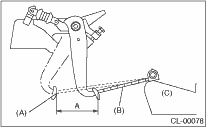
1. Measure the full stroke amount of the clutch pedal.
NOTE:
• Measure the leading end of the seat cushion and center of the pedal.
• Align the seat with the seventh notch position from the position at the very front.
Clutch pedal standard full stroke A:
130 — 135 mm (5.12 — 5.31 in)
|
(A) |
Clutch pedal (Full stroke condition) |
|
(B) |
Scale |
|
(C) |
Seat |
2. If the full stroke is not within the specified value, loosen the clutch stopper nut to adjust.
Tightening torque (Clutch stopper nut):
8 N·m (0.8 kgf-m, 5.8 ft-lb)
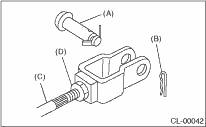
3. Loosen the push rod lock nuts.
|
(A) |
Clevis pin |
|
(B) |
Snap pin |
|
(C) |
Push rod |
|
(D) |
Push rod lock nut |
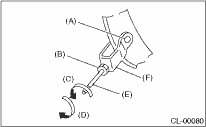
4. Rotate the push rod to adjust.
(1) Make sure that the clutch pedal hits the stopper bolt side when returning the clutch pedal.
(2) Check that the clutch pedal hits the clutch pedal bracket stopper at full stroke.
|
(A) |
Clevis hole |
|
(B) |
Push rod lock nut |
|
(C) |
In the longer direction |
|
(D) |
In the shorter direction |
|
(E) |
Push rod |
|
(F) |
U shaped hardware |
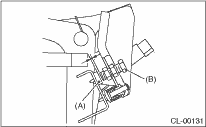
5. Rotate the push rod in the shorter direction to create clearance in the stopper bolt or the clutch switch side.
• Model without cruise control
|
(A) |
Stopper |
|
(B) |
Stopper bolt |
• Model with cruise control
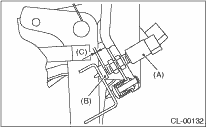
|
(A) |
Clutch switch |
|
(B) |
Stopper |
|
(C) |
Clearance |
6. Rotate the push rod in the shorter direction until the clutch pedal hits the stopper bolt.
7. Rotate the push rod further in the longer direction 270° (in the direction of the arrow in the drawing).
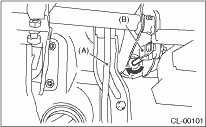
|
(A) |
Accelerator pedal |
|
(B) |
Clevis |
8. Check that the clevis pin moves smoothly by moving it in the left and right directions.
9. Tighten the push rod lock nut.
Tightening torque:
10 N·m (1.0 kgf-m, 7.2 ft-lb)
10. Measure the full stroke of the clutch pedal again.
Clutch pedal standard full stroke A:
130 — 135 mm (5.12 — 5.31 in)
11. Install the clutch switch. 
1. Measure the full stroke amount of the clutch pedal.
NOTE:
• Measure the leading end of the seat cushion and center of the pedal.
• Align the seat with the seventh notch position from the position at the very front.
Clutch pedal standard full stroke A:
130 — 135 mm (5.12 — 5.31 in)
|
(A) |
Clutch pedal (Full stroke condition) |
|
(B) |
Scale |
|
(C) |
Seat |
2. If the full stroke is not within the specified value, loosen the clutch stopper nut to adjust.
Tightening torque (Clutch stopper nut):
8 N·m (0.8 kgf-m, 5.8 ft-lb)
3. If the amount of stroke cannot be adjusted by adjusting the clutch stopper, remove the clutch switch.
4. Loosen the push rod lock nuts.
|
(A) |
Clevis pin |
|
(B) |
Snap pin |
|
(C) |
Push rod |
|
(D) |
Push rod lock nut |
5. Rotate the push rod to adjust.
(1) Make sure that the clutch pedal hits the stopper bolt side when returning the clutch pedal.
(2) Check that the clutch pedal hits the clutch pedal bracket stopper at full stroke.
|
(A) |
Clevis hole |
|
(B) |
Push rod lock nut |
|
(C) |
In the longer direction |
|
(D) |
In the shorter direction |
|
(E) |
Push rod |
|
(F) |
U shaped hardware |
6. Rotate the push rod in the shorter direction to create clearance in the stopper bolt side or the clutch switch side.
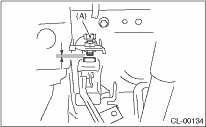
|
(A) |
Stopper bolt |
7. Rotate the push rod in the shorter direction until the clutch pedal hits the stopper bolt.
8. Rotate the push rod further in the longer direction 270° (in the direction of the arrow in the drawing).
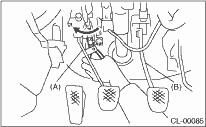
|
(A) |
Clutch pedal |
|
(B) |
Brake pedal |
9. Check that the clevis pin moves smoothly by moving it in the left and right directions.
10. Tighten the push rod lock nut.
Tightening torque:
10 N·m (1.0 kgf-m, 7.2 ft-lb)
11. Measure the full stroke of the clutch pedal again.
Clutch pedal standard full stroke A:
130 — 135 mm (5.12 — 5.31 in)
12. Install the clutch switch.