WARNING:
• Electrolyte is a toxic corrosive acid. Be careful when handling the fluid.
• Make sure the electrolyte does not come into contact with skin, eyes or clothing. Especially at contact with eyes, flush with water for 15 minutes and get prompt medical attention.
• In addition, be careful not to let the electrolyte contact coated parts.
• Be careful when handling batteries as they produce flammable gas.
• Be sure to keep the battery away from any fire.
• For safety, wear eye protection or shield your eyes when working near any battery in case an explosion does occur. In addition, never lean over the battery.
• Ventilate sufficiently when using or charging the battery in an enclosed space.
• Before starting work, remove rings, metal watch-bands, and other metal jewelry.
• Never allow metal tools to contact the positive battery terminal and anything connected to it while you are at the same time in contact with any other metallic portion of the vehicle.
Check the battery case, top cover, vent plugs, and terminal posts for dirt or cracks. If necessary, clean with water and wipe with a dry cloth. Apply a thin coat of grease on the terminal posts to prevent corrosion.
Check the electrolyte level in each cell. If the level is below the MIN level, fill the battery cell with distilled water up to the MAX level. Do not fill beyond MAX level.
3. SPECIFIC GRAVITY OF ELECTROLYTE
1. Measure specific gravity of electrolyte using a hydrometer and a thermometer.
Specific gravity varies with temperature of electrolyte so that it must be corrected at 20°C (68°F) using the following calculation:
S20 = St + 0.0007 × (t − 20)
S20: Specific gravity corrected at electrolyte temperature of 20°C (68°F)
St: Measured specific gravity
t: Measured temperature (°C)
Determine whether or not the battery requires charging according to corrected specific gravity.
Standard specific gravity: 1.220 — 1.290 [at 20°C (68°F)]
2. Measuring the specific gravity of the electrolyte in the battery will disclose the state of charge of the battery. The relation between specific gravity and state of charge is as shown in the figure.
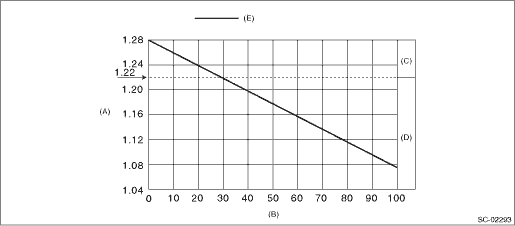
|
(A) |
Specific gravity [20°C (68°F)] |
(B) |
Amount of discharge (%) |
(C) |
Good |
|
(D) |
Need to charge |
(E) |
Battery with standard specific gravity 1.280 [20°C (68°F)] |