WARNING:
The radiator is of the pressurized type. Do not attempt to remove the radiator cap immediately after the engine has been stopped.
1. Lift up the vehicle.
2. Remove the under cover.
3. Place a container under drain pipe.
4. Loosen and remove the drain cock to drain engine coolant into container.
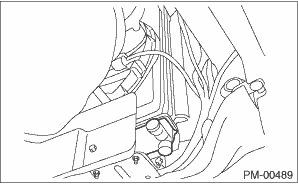
5. For quick draining, remove the radiator cap.
CAUTION:
Be careful not to spill coolant on the floor.
6. Drain the coolant from reservoir tank.
7. Tighten the radiator drain cock securely after draining coolant.
8. Fill the engine coolant into radiator (non-turbo model and diesel engine model) or coolant filler tank (gasoline turbo model) up to the filler neck position.
9. Fill engine coolant into the reservoir tank up to “FULL” level.
Coolant capacity

CAUTION:
Be careful not to spill engine coolant on the exhaust pipe to prevent it from emitting smoke or causing a fire. If engine coolant spilled, wipe it off completely with cloth.
10. Close the radiator cap (non-turbo model and diesel engine model) or the coolant filler tank cap (gasoline turbo model), start the engine and race 5 to 6 times at less than 3,000 rpm, then stop the engine. (Complete this operation within 40 seconds.)
11. Wait for one minute after the engine stops, then open the radiator cap (non-turbo model and diesel engine model) or the coolant filler tank cap (gasoline turbo model). If the engine coolant level drops, add engine coolant into the radiator filler neck (non-turbo model and diesel engine model) or the coolant filler tank filler neck (gasoline turbo model) up to the filler neck position.
12. Perform the procedures 10) and 11) again.
13. Properly install the radiator cap (non-turbo model and diesel engine model) or the coolant filler tank cap (gasoline turbo model), and the reservoir tank cap.
14. Start the engine and operate the heater at maximum hot position and the blower speed setting to “LO”.
15. Run the engine at 2,000 rpm or less until radiator fan starts and stops.
NOTE:
• Be careful with the engine coolant temperature gauge to prevent overheating.
• If the radiator hose becomes hardened with the pressure of engine coolant, air bleeding operation seems to be almost completed.
16. Stop the engine and wait until the engine coolant temperature drops to 30°C (86°F) or less.
17. Open the radiator cap (non-turbo model and diesel engine model) or the coolant filler tank cap (gasoline turbo model). If the engine coolant level drops, add engine coolant into the radiator filler neck (non-turbo model and diesel engine model) or the coolant filler tank filler neck (gasoline turbo model) up to the filler neck position. Then, pour the coolant into reservoir tank up to “FULL” level.
18. Properly install the radiator cap (non-turbo model and diesel engine model) or the coolant filler tank cap (gasoline turbo model), and the reservoir tank cap.
19. Set the heater setting to maximum hot position and the blower speed setting to “LO” and start the engine. Perform racing at 3,000 rpm or less. If the flowing sound is heard from heater core, repeat the procedures from step 15).
1. Lift up the vehicle.
2. Remove the under cover.
3. Remove the drain plug to drain engine coolant into container.
NOTE:
Remove the radiator cap so that engine coolant will drain faster.
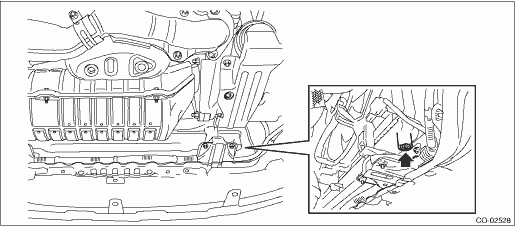
4. Install the drain plug.
5. Pour engine coolant into the radiator up to the filler neck position.
Recommended engine coolant:
Refer to “SPECIFICATION” for recommended engine coolant.
Engine coolant level:
Refer to “SPECIFICATION” for engine coolant level.
6. Open the air bleeding valve on the heater hose side.
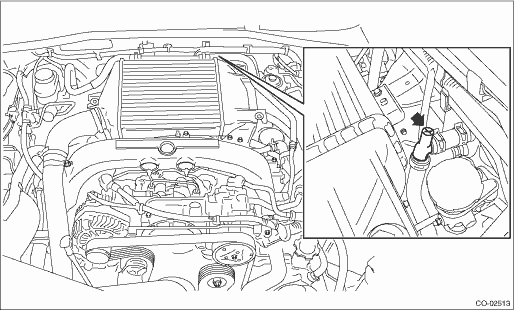
7. If the engine coolant level drops, add engine coolant into radiator up to the filler neck position.
8. Close the air bleeder valve when engine coolant comes out of the air bleeder valve on the heater hose side.
9. Fill engine coolant into the reservoir tank up to “FULL” level.
10. Close the radiator cap and start the engine. Race 5 to 6 times at 3,000 rpm or less, then stop the engine. (Complete this operation within 40 seconds.)
11. Wait for one minute after the engine stops, and open the radiator cap. If the engine coolant level drops, open the air bleeder valve on the heater hose side, and add engine coolant into the radiator up to the filler neck position.
12. Perform the procedures 6) and 7) again.
13. Attach the radiator cap and reservoir tank cap properly.
14. Start the engine and operate the heater at maximum hot position and the blower speed setting to “LO”.
15. Run the engine at 2,000 rpm or less until radiator fan starts and stops.
NOTE:
Be careful with the engine coolant temperature gauge to prevent overheating.
16. Stop the engine and wait until the engine coolant temperature drops to 30°C (86°F) or less.
17. Open the radiator cap. If the engine coolant level drops, add engine coolant into radiator up to the filler neck position and reservoir tank to the “FULL” level.
18. Attach the radiator cap and reservoir tank cap properly.
19. Set the heater setting to maximum hot position and the blower speed setting to “LO” and start the engine. Perform racing at 2,500 rpm or less. If the flowing sound is heard from heater core, repeat the procedures from step 9).