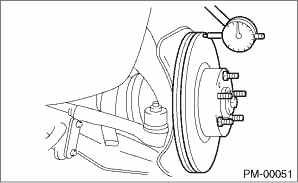
1. Jack up the vehicle and support it with rigid racks. Remove the wheels.
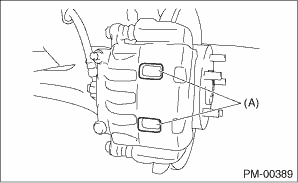
2. Visually check the pad thickness through inspection hole of disc brake assembly. Replace the pad if necessary.
NOTE:
When replacing a pad, always replace the pads for both the left and right wheels at the same time. Also replace the pad clips if they are twisted or worn.
|
(A) |
Inspection hole |
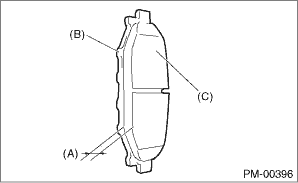
|
(A) |
Pad thickness |
|
(B) |
Back metal |
|
(C) |
Lining |
• Front (except for back metal)
|
Pad thickness |
mm (in) | |
|
Standard |
11 (0.43) | |
|
Wear limit |
1.5 (0.059) | |
• Rear (except for back metal)
|
Pad thickness |
mm (in) | |
|
Standard |
9 (0.35) | |
|
Wear limit |
1.5 (0.059) | |
3. Check the disc rotor, and correct or replace if it is damaged or worn.
• Front
|
Disc rotor thickness |
mm (in) | |
|
Standard |
24 (0.94) | |
|
Wear limit |
22 (0.87) | |
• Rear
|
Disc rotor thickness |
mm (in) | |
|
Standard |
10 (0.39) | |
|
Wear limit |
8.5 (0.33) | |
4. Remove the caliper body.  ,
,
5. Tighten the wheel nuts to secure disc rotor.
6. Set a dial gauge at a point less than 10 mm (0.39 in) from outer periphery of the rotor, and then measure the disc rotor runout.
Disc rotor runout limit:
Front: 0.050 mm (0.0020 in)
Rear: 0.050 mm (0.0020 in)